
|
Auditory Vigilance Task -- Identical to the standard (visual) Vigilance Task except that the subject responds to numbers that are heard instead of seen. To administer the task, the examiner covers the front display of the GDS (cover supplied) and places headphones (also supplied) on the subject’s head. All scores for the auditory version are gathered and calculated the same as for the standard task. Auditory Interference Task -- Instead of saying the precise number that appears on the front display, this task generates a random number through the headphones. The subject performs on the standard Vigilance (or Distractibility) tasks while having to contend with the confusing auditory input. Considered in the context of other clinical information, GDS data help the practitioner evaluate the impulsivepatient, generate treatment recommendations, and assess therapeutic outcome. It can be particularly useful in establishing levels of severity and in identifying the "well behaved" child with serious attention deficits. Objective data are also helpful when ratings from parents and teachers are clouded by disagreement or when the credibility of such reports is in doubt. GDS scores have also been found useful in the monitoring of pharmacotherapy.
|
|||
| Mail: PO Box 746, DeWitt, NY 13214 • Ph: 315-446-4849 • Fx: 315-446-2012 • EMail: info@gsi-add.com | ||||
| copyright © 2016 Gordon Systems Inc. Privacy Policy |
||||

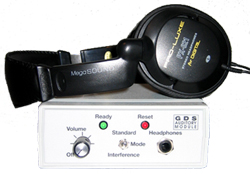 Because of the interest in testing auditory attention, we
have developed a module that can be added to any GDS. It allows the GDS to “speak” the digits that appear on
the front display. We have also included an Interference version which introduces auditory distraction to the
Vigilance Task. The auditory module uses the very latest in digital synthesis to produce remarkably clear and
natural speech. By simply connecting the auditory module to your GDS with a cable, you can administer the
following new tasks:
Because of the interest in testing auditory attention, we
have developed a module that can be added to any GDS. It allows the GDS to “speak” the digits that appear on
the front display. We have also included an Interference version which introduces auditory distraction to the
Vigilance Task. The auditory module uses the very latest in digital synthesis to produce remarkably clear and
natural speech. By simply connecting the auditory module to your GDS with a cable, you can administer the
following new tasks: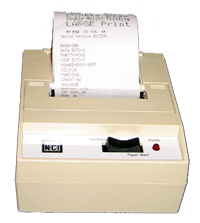 GDS Printer